Archives

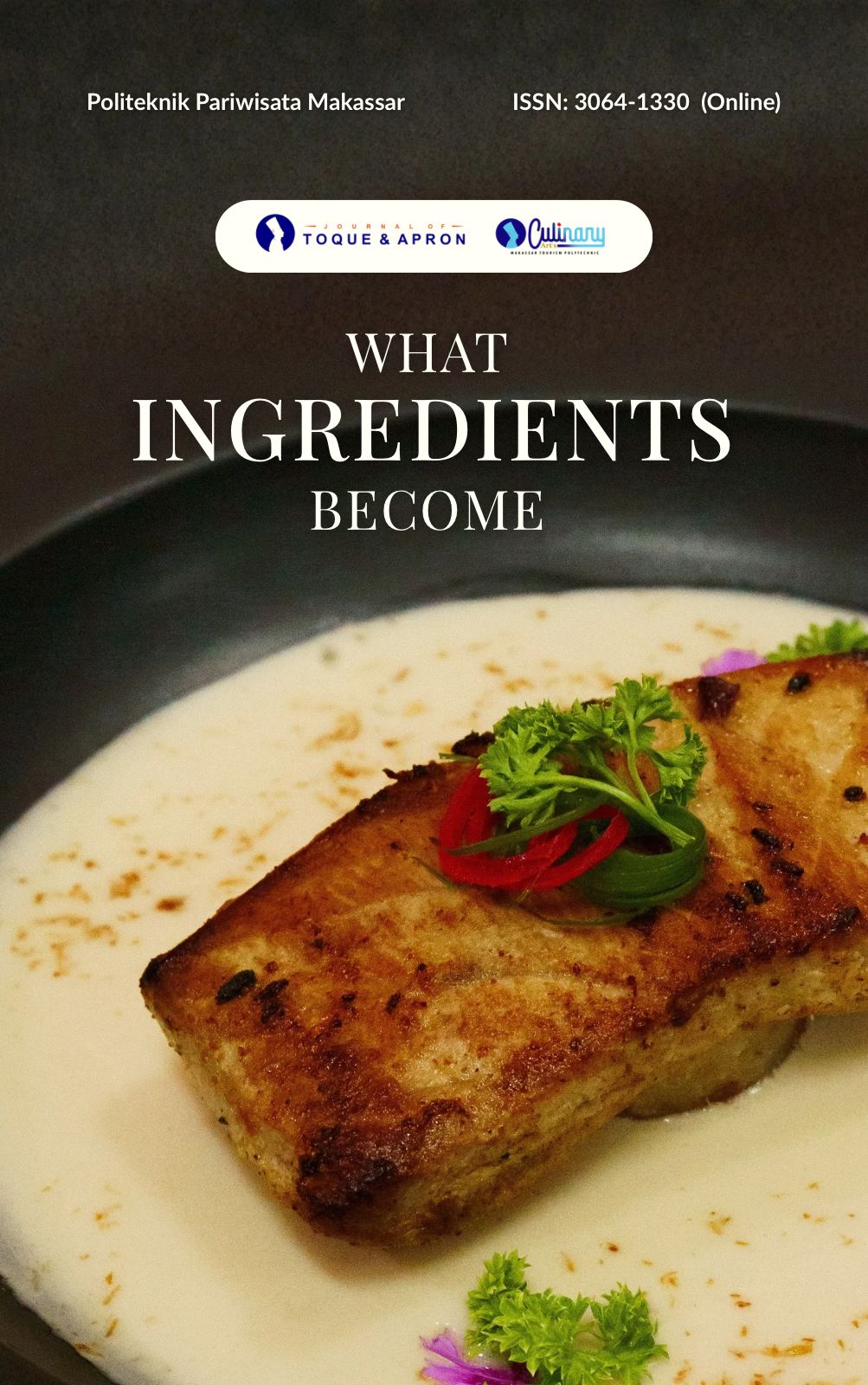
  • What Ingredients Become
    Vol. 2 No. 1 (2026)

    Ingredients do not enter the professional kitchen as neutral materials. Their qualities become visible through treatment: how they are cut, soaked, extracted, fermented, acidified, structured, seasoned, cooked, evaluated, and finally positioned as culinary products. Under the title What Ingredients Become, the articles in this volume examine that movement from raw material to culinary meaning, where technical intervention is inseparable from sensory judgment and practical use.

    The studies gathered here move across distinct but connected culinary processes. Vanilla planifolia is explored through glycerin-based extraction and its application in pastry products. Job’s Tears (Coix lacryma-jobi L.) is developed as a non-soy substrate for tempeh. Tamarind vinegar is examined as a souring ingredient in a standardized pickled-fruit preparation. Snakehead fish (Channa striata) meatballs are reformulated with κ-carrageenan to evaluate hedonic acceptability. Palekko seasoning is adapted into dry rub form for poultry dishes. Each article begins from a specific ingredient problem, yet each also asks a larger culinary question: what changes when an ingredient is subjected to methodical experimentation?

    Across these works, ingredient transformation is treated not as novelty for its own sake, but as disciplined culinary inquiry. Extraction, fermentation, acid development, hydrocolloid formulation, seasoning adaptation, and product standardization are used to clarify how ingredients behave, what functions they can assume, and how their sensory and cultural identities may be extended without losing practical relevance. The professional kitchen appears here as a site where materials are not only prepared, but also questioned, tested, and made to become something more precise.

  • Culinary Breakthroughs
    Vol. 1 No. 1 (2024)

    'Culinary Breakthroughs' refer to significant innovations and advancements in the culinary world that reshape traditional cooking practices and introduce modern techniques. This concept encompasses the creative transformation of classic dishes, using unconventional ingredients, and integrating new technologies in food preparation. By redefining established methods, culinary breakthroughs push the boundaries of conventional gastronomy, offering fresh perspectives and possibilities within the culinary arts.